Direct Air Capture and the Real Cost of Carbon Removal
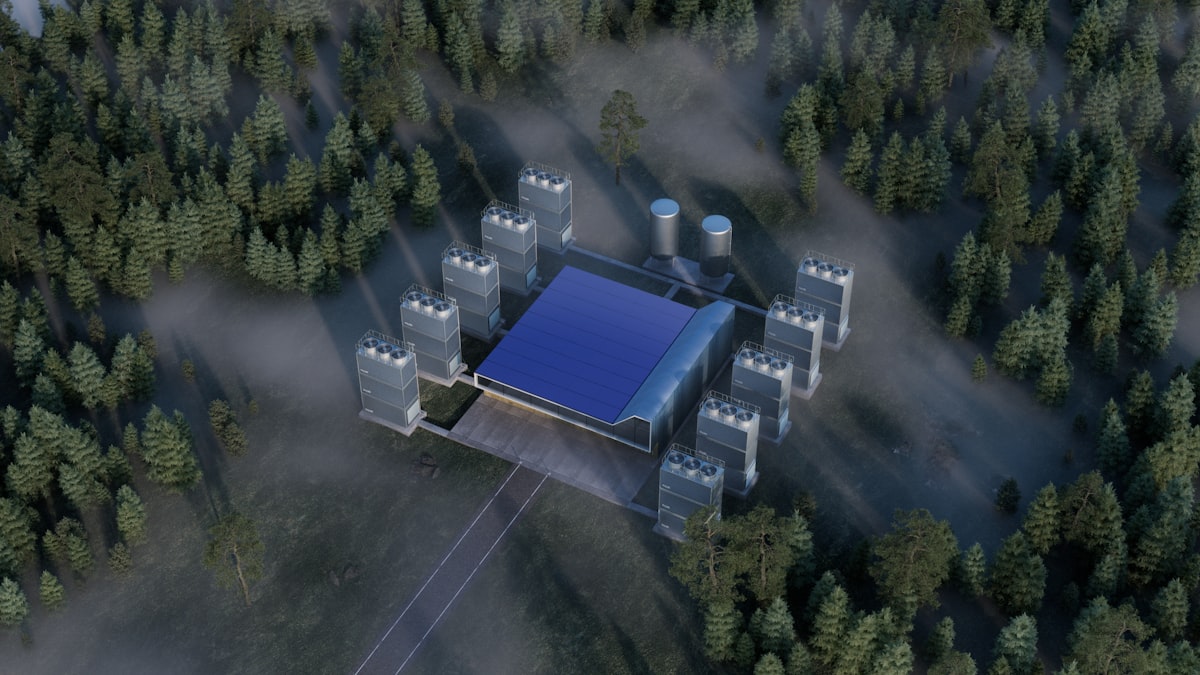
Direct air capture works. That was never really in doubt: the chemistry of pulling CO₂ out of ambient air has been understood for decades, and there are plants running today. The open questions are the cost per tonne, which is still roughly an order of magnitude above the numbers used in climate models, and the demand side, where one company has been buying most of the world’s durable carbon removal and paused new purchases in 2026.
Two chemistries, two very different plants
DAC has to concentrate a gas present at about 420 parts per million, which sets a thermodynamic floor on energy use and a practical floor on how much air you must move. There are two commercial approaches.
Liquid solvent systems pass air over an aqueous metal hydroxide, usually potassium hydroxide, which reacts to form a carbonate. That solution is reacted with calcium hydroxide to precipitate calcium carbonate, and the carbonate is then decomposed in a calciner at around 900°C to release a concentrated CO₂ stream and regenerate the loop. This is the Carbon Engineering process now being commissioned at scale in Texas. The high-temperature step is why these plants look like refineries and, historically, why they burned natural gas.
Solid sorbent systems use amine-functionalised material in modular collector units. Fans draw air through the sorbent, which is then regenerated with low-grade heat at roughly 100°C, often under partial vacuum, releasing CO₂ in batches. This is the Climeworks approach. It is modular, can run on geothermal or waste heat, and scales by adding boxes rather than by building a bigger plant.
The energy numbers are the crux. A peer-reviewed analysis in Frontiers in Climate modelled solvent-based DAC at 7.2 GJ of thermal plus 1.7 GJ of electrical energy per tonne of CO₂ for one design, and 5.8 GJ thermal plus 1.5 GJ electric for another, equivalent to roughly 1.9 to 2.3 MWh per tonne in all-electric configurations. The same paper put facility-only costs at $150 to $310 per tonne and gross capture costs at $220 to $690 per tonne depending on the energy source.
| Liquid solvent | Solid sorbent | |
|---|---|---|
| Regeneration heat | Calciner at about 900°C | Low-grade heat, around 100°C |
| Plant shape | Single large process facility | Modular collector units |
| Scales by | Building bigger trains | Adding modules |
| Energy source options | Gas or high-temperature electric | Geothermal, waste heat, heat pumps |
| Reference plant | STRATOS, Ector County, Texas | Mammoth, Hellisheiði, Iceland |
The plants that actually exist
Climeworks switched on Mammoth in Iceland on 8 May 2024, with a nameplate capacity of up to 36,000 tonnes of CO₂ a year and mineral storage through Carbfix. It was the largest DAC plant in the world at the time. Reported actual capture has run well below nameplate, and Climeworks made its first significant round of layoffs in May 2025.
The bigger facility is STRATOS, built by Occidental subsidiary 1PointFive on a 65-acre site in Ector County, Texas, designed for up to 500,000 tonnes a year using Carbon Engineering’s liquid solvent technology. It received its Class VI injection well permit in April 2025. Per Oil & Gas Journal, Phase 1 was in final startup in the second quarter of 2026, with Phase 2 commissioning beginning in the same quarter and ramp-up continuing through the rest of the year; three wells are planned to store roughly 722,000 tonnes annually in saline formations.
The announced pipeline in the United States runs through the Department of Energy’s $3.5 billion Regional DAC Hubs programme. Two hubs matter: Project Cypress in Louisiana, a Battelle-led team with Climeworks and Heirloom, awarded up to $600 million with an initial $50 million tranche in March 2024 and a target of 1 million tonnes a year by 2030; and the South Texas DAC Hub in Kleberg County, awarded up to $500 million with an initial $50 million in September 2024, targeting 500,000 tonnes scaling past 1 million. Both were reported in late 2025 as candidates for cancellation. DOE confirmed in April 2026 that it would keep them, with $1.2 billion earmarked for the two hubs in the FY2027 budget request and $2.3 billion of the original programme proposed for rescission.
What a tonne actually costs
Climeworks has been unusually direct about this. Speaking to Canary Media, the company put its current cost at around $1,000 per tonne of captured CO₂ and its 2030 target at $250 to $350 per tonne, on the back of a third-generation sorbent it says captures twice as much CO₂, uses half the energy per tonne and lasts about three times longer. Chief operating officer Douglas Chan said “Generation 3 is what matters as we move ahead. That is going to be the basis of how we scale and continue to scale Climeworks throughout the industry.”
Note what that target is not. The $100-per-tonne figure that appears in most integrated assessment models is not on anyone’s near-term roadmap, and Climeworks itself has publicly said DAC costs will exceed it for the foreseeable future. Treat $100 per tonne as a modelling convenience, not a forecast.
A worked example on the tax credit
US Section 45Q pays $180 per tonne for DAC with geological storage and, before the One Big Beautiful Bill Act, $130 per tonne for utilisation. The Act, signed 4 July 2025, levelled those values so all qualifying sequestration uses receive the higher credit, with inflation adjustment for projects beginning after the start of 2027.
- At Climeworks’ stated current cost of about $1,000 per tonne, a $180 credit covers 18% of the bill. The remaining $820 has to come from a voluntary buyer.
- At the 2030 target of $250 to $350 per tonne, the same credit covers 51% to 72%. The residual falls to roughly $70 to $170 per tonne.
- That second case is a business. The first one is a grant-funded demonstration wearing a price tag.
A market with one buyer, and what happened when it stopped
Durable carbon removal purchases are extraordinarily concentrated. According to CDR.fyi data published on 13 April 2026, 46.4 million tonnes had been contracted to date, of which Microsoft accounted for 36,439,157 tonnes, or 78.5%. Frontier-linked buyers, the Stripe-organised advance market commitment, made up 1.84 million tonnes, or 4.0%. The same analysis notes that Microsoft and Frontier together represent about 10% of tonnes actually delivered, while everyone else accounts for 90%.
Then the largest buyer stopped. Bloomberg and Heatmap reported in April 2026 that Microsoft had told suppliers it was pausing new carbon removal purchases, with the company saying only that it “continually review[s] and assess[es] our carbon removal portfolio along with market conditions”. Microsoft had signed agreements for roughly 45 million tonnes in 2025, about double its 2024 volume.
In the third quarter of 2025, 8.5 million tonnes of durable removal were contracted, of which Microsoft took 7.9 million. Actual deliveries that quarter were 83,610 tonnes, mostly biochar, with about 60% from Global South suppliers.
The delivery figure is the one to hold on to. Contracts are a decade of promises; deliveries are the industry’s real output, and annualised they run in the hundreds of thousands of tonnes against global emissions in the tens of billions.
The criticism, taken seriously
The strongest objection is not that DAC is fake. It is opportunity cost. At $1,000 a tonne, the same capital deployed on avoided emissions buys far more abatement, and biochar and enhanced weathering are already delivering tonnes at lower prices; one Frontier deal with Planetary in 2025 valued 115,000 tonnes of ocean alkalinity enhancement at $31.3 million, about $218 a tonne. Those pathways carry their own measurement problems, particularly permanence and verification, but they are shipping now.
The second objection is moral hazard: a credible promise of future removal weakens the case for cutting emissions today. The third is siting and power. A DAC plant needs clean firm energy at scale, and in most grids that energy has a better immediate use displacing fossil generation.
The defence is narrow but real. Some emissions have no substitute technology, permanence matters for legal and accounting purposes, and geological storage of CO₂ in saline formations is measurable in a way that soil carbon is not. DAC is best understood as insurance being built early because it takes decades to industrialise, not as a lever anyone can pull this decade.
How to buy removal without getting burned
- Contract on delivered tonnes, not capacity. Nameplate has consistently overstated output at operating DAC plants. Pay against verified delivery with a defined measurement protocol.
- Ask where the energy comes from. A tonne captured with grid power in a fossil-heavy region can approach net zero benefit. Insist on the full life-cycle accounting, not the capture figure.
- Diversify pathways. A portfolio spanning biochar, enhanced weathering and a small DAC allocation buys optionality on both price and permanence risk.
- Check counterparty durability. Several suppliers depend on a single buyer or a single grant. Ask what happens to your 2032 delivery if either disappears.
- Model the subsidy. If a project’s economics need 45Q, confirm the credit applies to its storage route and that the project starts inside the eligible window.
Sources
- 1PointFive — STRATOS, Ector County Direct Air Capture Facility
- Oil & Gas Journal — Oxy’s 1PointFive expects STRATOS DAC plant online in Q2 2026
- Climeworks — Mammoth direct air capture and storage facility
- Canary Media — Climeworks says new tech can halve costs and energy use
- Frontiers in Climate — Natural Gas vs. Electricity for Solvent-Based Direct Air Capture
- CDR.fyi — Durable CDR Demand Structure Snapshot, April 2026
- ESG Today — Microsoft Pauses Carbon Removal Purchases
- Payne Institute — Key changes for 45Q tax credits under the One Big Beautiful Bill Act



Post Comment